How Does a Cooling Blanket Work? The Quick Answer
How does a cooling blanket work? Not by making cold — by moving heat. A cooling blanket is engineered fabric that speeds up heat transfer away from your body through conduction (cool-to-the-touch fibers), evaporation (moisture wicking) and airflow (a breathable weave), rather than trapping warmth against your skin the way a traditional duvet does.
That single idea rests on the most basic rule in thermodynamics: heat always flows from hot to cold. No fabric can refrigerate you. What a well-designed blanket can do is change how fast the roughly 100 watts of heat your resting body produces escapes into the room — or gets trapped in a humid pocket under the covers.
In this guide, we'll unpack the four mechanisms that make a blanket genuinely "cooling": conductive cool-to-the-touch fibers (measured by a lab number called Qmax), moisture-wicking fabric, breathable weaves, and phase change materials (PCM). Then we'll get honest about the physics — why the icy first touch always fades, what the research actually shows, and how to keep a good blanket performing for years.

Why Your Body Needs to Shed Heat to Fall Asleep
Falling asleep is partly a thermal event. Your core body temperature runs on a circadian rhythm: it drops by about 0.3°C (0.5°F) in the hours before bedtime and keeps drifting downward through the night, reaching its low point in the early morning. Sleep researchers writing in the Journal of Physiological Anthropology have shown that heat exposure which blocks this natural drop increases wakefulness and suppresses both deep sleep and REM sleep.
To dump that heat, your body dilates the blood vessels in your skin and pushes warmth outward — warm hands and feet are literally a signal that sleep is coming. Your bedding sits directly in the path of this heat dump. If it insulates too well, skin temperature creeps up, tiny thermosensors in your skin fire, and you get the familiar routine: kicked-off covers, flipped pillows and 3 a.m. micro-awakenings that fragment the night. We unpack the physiology in our guide to how thermoregulation controls your rest and the follow-up on why you sleep worse when it's hot.
The Sleep Foundation recommends a bedroom of roughly 65–68°F (18–20°C). Hot climates, shared duvets, foam mattresses and hormonal shifts push millions of sleepers — the hot sleepers this whole category exists for — well outside that window. That's the gap cooling bedding is built to close: not by chilling you, but by letting your body's own cooling system run at full speed.
The 4 Mechanisms That Make a Blanket "Cooling"
A quick map before the details. Cooling bedding splits into two families: passive cooling, which is pure fabric physics and covers every consumer cooling blanket, and active cooling — powered mattress pads that circulate chilled water or run thermoelectric elements. This article is about passive cooling; if you'd like the ground-floor introduction first, start with what a cooling blanket is — the plain-English basics, then come back here for the machinery.
Here's the part worth remembering as you shop: quality cooling blankets stack several of the four mechanisms below, while cheap ones often lean on a single chemical finish that washes out within a few months. Learning to tell the difference is the whole game.
Conduction: Cool-to-the-Touch Fibers
Why does a metal door handle feel colder than a wooden one in the same room? They're at the same temperature — metal simply conducts heat out of your hand much faster, and your nerves read rapid heat loss as "cold." Cooling fabrics exploit exactly this effect. Fibers such as nylon, polyethylene and certain regenerated cellulose have a thermal conductivity several times higher than cotton or ordinary polyester, so the instant your skin lands on them, heat rushes out and you feel a genuine chill.
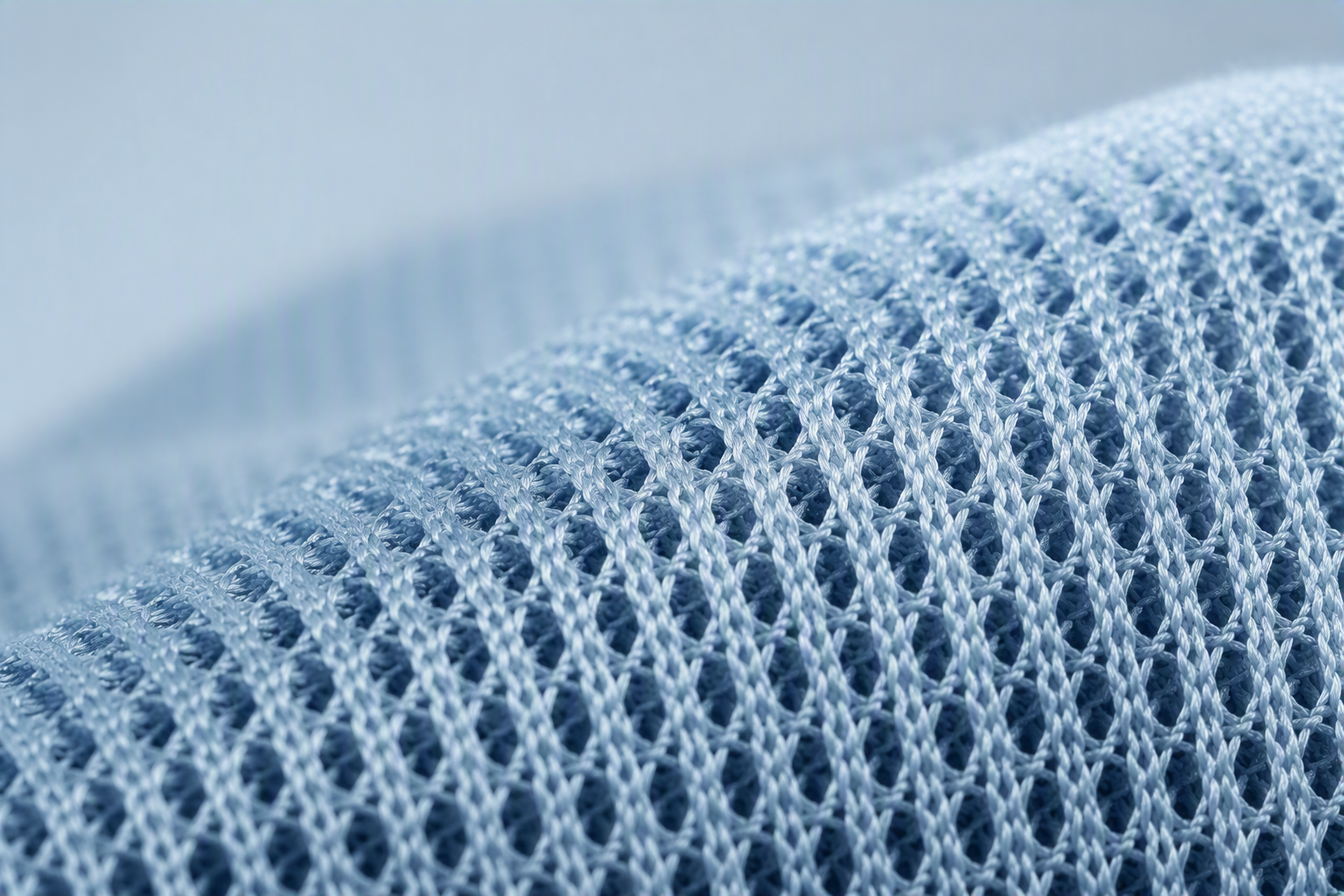
The weave matters as much as the fiber. Smooth, flat, dense knits maximize the contact area between skin and fabric — more contact means more escape routes for heat. That's why real cooling fabrics feel slick and almost liquid rather than fluffy: loft traps air, trapped air is insulation, and insulation is precisely what you don't want here. Some manufacturers push further by embedding thermally conductive mineral particles — jade and mica are the common ones — into the fiber itself to raise heat transfer another notch.

Qmax: The Number That Measures "Cool Touch"
The contact chill isn't just a feeling — it has an objective score. Qmax is the maximum instantaneous heat flux, measured in watts per square centimetre (W/cm²), recorded when a warm plate first touches a fabric sample. It's standardized under Japan's JIS L 1927 (using the Kawabata Thermo Labo method) and the related ASTM D7984, and it's the only widely used lab measurement of "coolness" in bedding.
Here's the reference ladder almost nobody publishes:
- 0.1 W/cm² — the official JIS threshold for calling a fabric "instant cooling"
- ≈0.11 W/cm² — ordinary cotton, which barely clears the bar
- ≈0.19 W/cm² — natural silk
- 0.2–0.5 W/cm² — engineered cooling fibers, with 0.3+ being premium territory
A practical shopping rule: a serious cooling claim should come with a published Qmax rating of at least 0.2. This is why Breeza prints verified Qmax figures on its product pages — the number is lab-testable, while "advanced cooling technology" is just an adjective.
One honest caveat before you fall in love with big numbers: Qmax only describes the first few seconds of contact. It says nothing about hour six of a humid July night. For that, you need the next two mechanisms.
Moisture Wicking, Evaporation and Airflow: What Works All Night
Evaporative cooling is the most powerful heat-loss tool your body owns — every gram of sweat that evaporates carries away about 2,400 joules of heat. Wicking fabrics amplify it through capillary action: microscopic channels between the fibers pull moisture off your skin and spread it across a wide swath of fabric, where it evaporates far faster than it would sitting in a clammy film on your back.
This is the mechanism that matters most for night sweats and hot flashes. Staying dry instead of damp breaks the miserable cycle of sweating, chilling and re-overheating that wakes people at 2 a.m. (Night sweats can also have medical causes worth ruling out — Mayo Clinic has a good overview — and we cover the full picture in our guide to the causes of night sweats and how cooling bedding helps.)
Breathability is the unsung hero of all-night comfort. An open, breathable weave and a light fabric weight — roughly 200–350 GSM (grams per square metre) for a summer-weight blanket — let convection carry warm, humid air up and away instead of pooling it under the covers. Long after the cool-touch chill has faded, breathability keeps quietly doing its job.
And an honest note most brands skip: if you sleep dry in a cool room, wicking adds very little. In that scenario, conduction and breathability are doing the real work. Wicking earns its keep on humid nights and for genuinely sweaty sleepers.

Phase Change Materials (PCM): Heat Batteries Woven Into Fabric
Phase change material technology was originally developed for NASA spacesuits, where astronauts swing between brutal heat and cold. In bedding, PCM comes as microscopic capsules of paraffin or polymer blended into the fabric and tuned to melt at around 82–88°F (28–31°C) — just below skin temperature.
The mechanism is elegant. As you warm up, the capsules melt and absorb your excess heat, the same way ice absorbs heat in a drink — except the wax stays sealed inside its shell, so nothing ever feels wet. When you cool down later, the capsules re-solidify and release that stored heat back. PCM doesn't "make cold"; it buffers temperature swings in both directions, more like cruise control than air conditioning.
Two limits to know. First, capacity is finite — once every capsule has melted, PCM absorbs nothing more until it gets a chance to re-solidify. Second, the microcapsule finish is fragile: hot washes and dryer heat degrade it permanently, which is a big part of why cooling blankets "die." More on that in the care section below.
How Does a Cooling Blanket Work All Night? The Honest Physics
Here's the part glossy product pages won't tell you. Any passive fabric touching your 91°F (33°C) skin will reach skin temperature within minutes — that's thermal equilibrium, and no weave, mineral or marketing budget can repeal it. The dramatic first chill always fades. Slide your leg to a fresh patch of blanket and the chill returns, because that patch is still sitting at room temperature. Every hot sleeper knows the ritual.
So what actually works all night is not the chill — it's the blanket refusing to trap heat. Think of a cooling blanket as a heat valve rather than a refrigerator. Under a conventional duvet, the microclimate around your body can climb into the low 90s°F (mid-30s°C) with humidity to match; a breathable, wicking, conductive blanket keeps that microclimate much closer to room conditions all night long. The benefit is quieter than a burst of cold, but it's the one that shows up in how often you wake.
One more boundary worth stating plainly: passive cooling needs a temperature gradient. In a very hot, still, humid room there is simply nowhere for your heat to go, and no fabric can fix that. A fan transforms the equation by feeding evaporation and convection; air conditioning trumps everything in serious heat. When a skeptic tells you cooling blankets are "just marketing," this is the half-truth they're gesturing at — the fix is realistic expectations, not abandoning the category.

What Is Ice Silk — and Why Does It Feel So Cold?
"Ice silk" — the material behind most viral cooling blankets — is a commercial name, not a fiber standard, and it contains no actual silk. It's typically a regenerated cellulose (viscose or modal) or a nylon blend engineered for high thermal conductivity and an unusually smooth surface.
The engineering is real, though. Many ice silk fabric yarns are extruded with a cross-shaped cross-section, which creates micro air channels for moisture transport, while the smooth filament surface maximizes skin contact for conduction. The result is a fabric surface that can sit roughly 3–5°C (5–9°F) cooler than cotton in the same room and deliver a Qmax two to three times higher.
Quality varies enormously under that one name. Cheap versions get their chill from a silicone softener finish that washes out within months; better ones spin the cooling performance into the fiber itself, where it lasts for years. Breeza's Cooling Ice Silk Blanket takes the woven-in approach with a published Qmax rating — which is the standard we'd suggest holding any brand to: ask whether the coolness lives in the fiber or in a finish.
Do Cooling Blankets Actually Work? What the Research Says
The honest answer: yes, with modest and specific benefits — and the research base is thinner than anyone selling them would like.
The most direct evidence is a small 2021 crossover study in which 20 participants slept on heat-wicking cooling sheets in a bedroom set 3°C (5.4°F) warmer than their preferred temperature — and still rated their comfort as high as with regular sheets at the temperature they'd chosen. Small sample, real signal: engineered fabric bought back about three degrees of room heat.
Beyond that single product trial, the strongest science supports the mechanism rather than any particular blanket: core body temperature must fall for sleep onset, heat exposure measurably fragments sleep, and bedding is a major lever on the microclimate around your body. A cooling blanket helps your body do what it's already trying to do — nothing more, nothing less.
Who benefits most in practice: hot sleepers, people with menopausal night sweats and hot flashes, those on medications that trigger sweating, sleepers in humid climates, and couples sharing a duvet (two bodies means roughly double the heat under one cover).
And the realistic-expectations paragraph we promised: a cooling blanket is a heat-management tool, not air conditioning. In dangerous heat — indoor temperatures above about 90°F (32°C) — health agencies such as the CDC advise active cooling: AC, cooling centers, cool showers. Bedding is comfort gear, not safety equipment.
Cooling Blanket vs Cooling Quilt vs Other Cooling Bedding
Same physics, different jobs:
- Cooling blanket — a high-Qmax contact layer for warm nights: maximum skin-touch chill, minimal insulation.
- Cooling quilt / summer quilt — light, breathable fill for people who want the weight and coziness of a proper cover year-round; a summer quilt trades a little contact chill for gentle, non-trapping warmth.
- Cooling sheets — the base layer beneath you, applying the same fiber logic to your mattress surface.
- Active cooling pads — powered water or thermoelectric systems: the strongest effect and the highest price, with pump noise and maintenance in the bargain.
One blind spot worth fixing: your head is one of the body's busiest heat-dissipation zones, and the blanket never touches it. A cooling pillow — a heat-conductive cover over ventilated memory foam, like the Cooling Memory Pillow — and a breathable 3D sleep mask extend the same physics above your shoulders.
The layering rule: one conductive contact layer plus one breathable insulation layer beats piling on "cooling" products. Every extra layer adds insulation, no matter what its label promises.
How to Choose a Cooling Blanket That Actually Works
The checklist, with actual numbers:
- A published Qmax of 0.2 W/cm² or higher — 0.3+ is premium territory.
- Fiber content disclosed — nylon, polyethylene, viscose or modal beat plain polyester.
- Light fabric weight — around 200–350 GSM for warm-weather use.
- A smooth, flat, dense weave — slick hand-feel, not fluff.
- OEKO-TEX certified — Standard 100 means the fabric was tested for harmful substances, which matters for something touching your skin eight hours a night.
- An independent test report beats any adjective in a product description.
Red flags: claims that a blanket "stays cold all night" (physically impossible for passive fabric), no fiber content listed anywhere, and chill that comes from a coated finish rather than the fiber itself. We compare specific picks against these exact criteria in our cooling blanket buying checklist.
Care: Keep the Cooling Working for Years
Because cooling performance lives in fiber surfaces and delicate finishes, laundry technique decides how long it survives:
- Wash cold — below 86°F (30°C) — on a gentle cycle.
- Use a mild detergent; skip bleach entirely.
- Put delicate weaves in a mesh laundry bag and add an extra rinse.
- Air dry, out of direct sun.
Two killers do most of the damage. Fabric softener coats fibers in a waxy film that blocks wicking, and dryer heat permanently degrades cooling finishes and melts PCM capsules — together they answer the painfully common question, "why did my cooling blanket stop working?" With good habits, expect 3–5 years of performance; a blanket that's gone gradually lukewarm is usually carrying body-oil and detergent residue, and a stripping wash often revives it. Full step-by-step instructions live in our guides on how to wash a cooling blanket the right way and how to restore a blanket that's lost its chill.

Beyond the Blanket: 7 Ways to Sleep Cooler Tonight
A cooling blanket works best as one part of a cooler sleep system:
- Set the room to 65–68°F (18–20°C) if you can — thermostat, open window, whatever gets you there.
- Aim a fan across the bed — moving air feeds both evaporation and convection, effectively supercharging your blanket.
- Black out windows during the day to stop solar gain before it reaches your bedroom.
- Take a warm shower 1–2 hours before bed — the rebound blood-vessel dilation dumps core heat right on schedule.
- Hydrate through the evening so your sweat-based cooling has something to work with.
- Eat lighter, earlier dinners — digestion generates heat.
- Give your head a cool surface too — flip the pillow, or use a heat-conductive pillow cover.
For the full toolkit, see our 15 tricks to sleep cool without air conditioning — and for setup, timing and pairing advice, our companion guide has more ways to sleep cooler on hot nights.
The Bottom Line
So — how does a cooling blanket work? By being a better exit for heat, not a source of cold. Conductive fibers deliver the instant Qmax chill, moisture wicking and a breathable weave quietly ferry heat and humidity away all night, and PCM smooths out the swings in between. The icy first touch will always fade — that's physics — but a blanket that refuses to trap heat is exactly what a body trying to cool itself down for sleep needs. Choose one with published numbers, wash it cold, keep it away from the dryer, and pair it with a fan and a cool, dark room. Your 3 a.m. self will notice the difference.