How to Wash a Cooling Blanket Without Ruining the Chill
Exact machine settings, detergent rules and drying methods that get a cooling blanket clean without destroying the cool-to-touch effect that helps you sleep.
Jul 2026· 18 min read
Key takeaways
Wash a cooling blanket in cold water (30°C/86°F max) on a delicate cycle with a half dose of mild liquid detergent, an extra rinse, and a spin speed of 800 rpm or less.
Never use fabric softener, dryer sheets or chlorine bleach — they coat cool-touch fibers with a waxy film or degrade them outright, which is why clean blankets can stop feeling cold.
Air dry out of direct sunlight (4–8 hours); use a dryer only if the label allows, on no or lowest heat. One hot dryer cycle can permanently destroy Q-max cooling performance.
Match settings to material: ice silk and PCM fabrics are strictly cold-wash and air-dry, bamboo shrinks under heat, and cotton-blend quilts are the most forgiving.
Wash every 2–4 weeks with nightly skin contact, monthly over a top sheet, and always before storage — more often with night sweats, pets or allergies.
If the blanket stopped feeling cool, run a strip wash: cold, gentle, zero detergent, double rinse. Residue is the usual culprit and it is fully reversible; heat damage is not.
To wash a cooling blanket safely, use cold water (30°C / 86°F or below), a gentle cycle, a half dose of mild liquid detergent, and an extra rinse — then air dry it flat, away from direct sun. No bleach, no fabric softener, and no hot dryer. Ever.
That is the short version of how to wash a cooling blanket without ruining the chill. The long version — exact settings, detergent choices, drying times, material-by-material rules and a rescue protocol for a blanket that no longer feels cold — is below. It matters more than most laundry advice, because the majority of “broken” cooling blankets were never worn out. They were washed wrong, often just once.
A solo load in a front loader on a cold, gentle cycle is the safest machine wash for a cooling blanket.
The 30-Second Answer: Correct Wash Settings for a Cooling Blanket
If you only remember one list, make it this one:
Cycle: delicate or gentle (use the bedding/bulky setting on a front loader for large quilts)
Water temperature: cold — 30°C / 86°F maximum
Spin speed: low, 800 rpm or less
Detergent: mild, bleach-free liquid detergent at half the normal dose (roughly 25 ml, or about 2 tablespoons)
Softener and dryer sheets: never
Rinse: add an extra rinse cycle
Load: wash the blanket alone, or inside a large mesh laundry bag
Drying: air dry out of direct sunlight; tumble dry only if the care label allows it, on no heat or the lowest heat setting
Frequently asked questions
Share
Ready to shop?
Explore the Breeza range with free shipping and 30-day returns.
One caveat overrides everything above: the care label sewn into your specific blanket. Generic settings are a safe fallback, not a substitute — and because cooling-bedding labels are dense with symbols, we decode the common ones a little further down.
Why Cooling Blankets Need Different Laundry Rules
A cooling blanket is not just fabric; it is a small heat-transfer device. Understanding how cooling fabrics actually pull heat away makes every rule in this guide obvious rather than arbitrary. If you are brand new to the category, start with what a cooling blanket is and come back — the wash rules will make far more sense.
Most cooling blankets rely on one or more of three mechanisms, and each one has its own failure mode in the laundry:
Cool-to-touch fibers. “Ice silk” and similar knits blend fine nylon or viscose filaments into a dense, smooth surface that conducts heat away from your skin. Labs measure this as Q-max, in watts per square centimeter of instant heat flow: ordinary cotton sits around 0.1–0.14 W/cm², cool-touch fabrics start near 0.2, and premium ice-silk knits reach 0.3–0.4. Heat is the enemy here — hot water and hot dryers warp those fine filaments, and once the smooth surface is deformed, the Q-max value drops for good.
Moisture-wicking weaves. These move sweat off your skin through capillary channels in the weave. Detergent overdose and fabric softener clog those channels with residue.
Phase-change materials (PCM). Microcapsules tuned to absorb heat by melting around 18–28°C (64–82°F). Hot water and dryer heat cycle them far outside their design range and degrade them.
The residue mechanism deserves one more sentence, because almost nobody explains it: fabric softener and excess detergent leave a thin, waxy, water-repellent film on fibers. That film sits between your skin and the cool-touch surface like a microscopic insulation layer — so the blanket feels warmer even though it is perfectly clean. This is the single most common reason a freshly washed cooling blanket “stops working.”
Heat damage, by contrast, is cumulative and permanent. One hot dryer cycle can do more harm to cooling fibers than a year of nightly use. That is worth protecting: research on thermal environment and sleep published in the Journal of Physiological Anthropology shows bed microclimate directly affects sleep quality, and the Sleep Foundation puts the ideal sleeping environment around 65–68°F (18–20°C). Your blanket is part of that system.
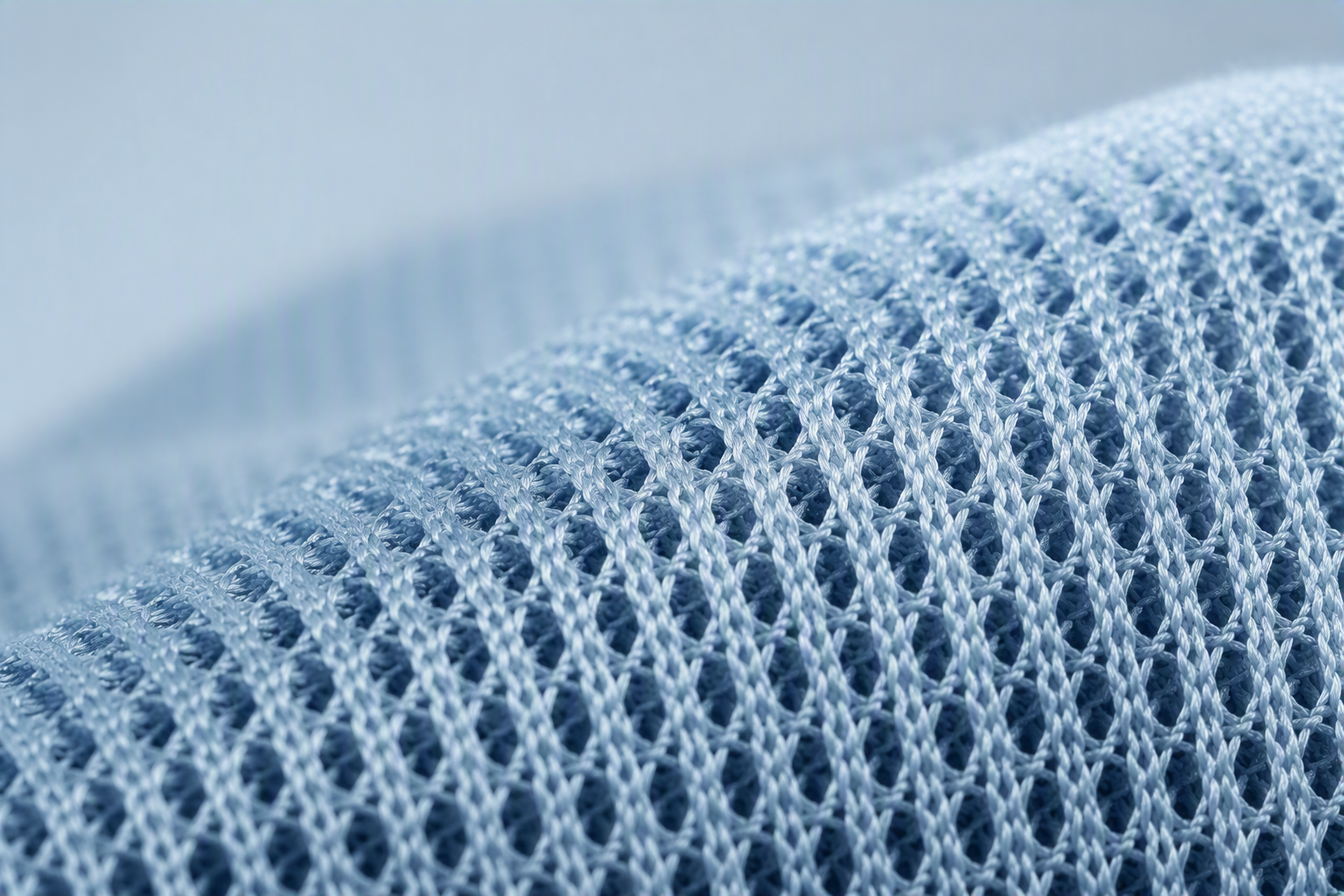
The dense, smooth knit that creates the cool-to-touch effect is exactly what heat and residue destroy.
Before You Wash: Read the Label and Prep the Blanket
A 20-Second Care-Label Decoder
Cooling-bedding labels use a handful of symbols worth memorizing:
Wash tub with “30”: machine wash cold, 30°C / 86°F maximum
Wash tub with a hand: hand wash only
Crossed-out triangle: no bleach of any kind
Square with a circle inside: tumble drying is allowed — one dot means low heat; crossed out means no dryer, ever
Crossed-out iron: never iron (nearly universal on cooling bedding)
Circle with a letter: professional dry cleaning with specific solvents; a crossed-out circle means no dry cleaning
Pre-Treat Stains — Gently
Dab stains with diluted mild detergent and cold water. Dab, never scrub — scrubbing abrades the fine knit and creates a permanently fuzzy (and warmer) patch. For sweat rings and body-oil marks, spray a 1:4 mix of white vinegar to cold water, let it sit for ten minutes, then wash. Never use hot water on protein stains like sweat or blood; heat cooks the proteins into the fiber and sets the stain.
Three Quick Prep Steps
Shake the blanket out outdoors to release dust, skin flakes and pet hair.
Close every zip and button if the blanket lives in a duvet cover, and wash the cover separately.
Run your hand along the seams and trim any loose threads so they cannot snag mid-cycle.
How to Machine Wash a Cooling Blanket (Step by Step)
Wash it alone, or in a large mesh laundry bag. Zippers, hooks, bra wires and even rough towels snag fine cool-touch knits and start pilling. A solo load also lets the blanket move freely, which cleans better at low agitation.
Select the delicate or gentle cycle. Top loaders with a central agitator are the roughest machines in the house — use the bulky/bedding setting if you have one, or take a large quilt to a laundromat front loader.
Set the water to cold, 30°C / 86°F or below. Cold protects cool-touch filaments, PCM capsules and elastic threads all at once.
Add a half dose of mild, bleach-free liquid detergent. Liquid, not powder: undissolved powder granules and overdosing are the number-one cause of clogged wicking channels. About 25 ml (2 tablespoons) is plenty for a lightly soiled blanket.
Skip fabric softener entirely. No exceptions — the softness it fakes is exactly the waxy film that kills contact cooling.
Run an extra rinse and keep the spin at or below 800 rpm. The extra rinse flushes residual detergent; the low spin prevents the drum from stretching a heavy, waterlogged knit out of shape.
Expect the full cycle to take a little over an hour with the extra rinse. That patience is cheaper than a replacement blanket.
How to Hand Wash a Cooling Blanket
Hand washing: cold water, a little neutral detergent, and gentle pressing — never twisting.
Hand washing is the gold standard for honeycomb or mesh-backed ice-silk pieces, anything labeled hand-wash-only, and blankets too large for your machine.
Fill a clean tub with cold water and a small squeeze of neutral liquid detergent.
Submerge the blanket and soak for no more than 15 minutes.
Gently press the suds through the fabric with flat palms. Never scrub, twist or wring — twisting shears the fine filaments.
Drain, then rinse in fresh cold water two or three times until the water runs clear.
Press the water out by rolling the blanket between two dry towels. Squeeze the roll; do not wring it.
Drying a Cooling Blanket: Air-Dry First, Dryer Rules Second
Air drying is the canonical method. Lay the blanket flat on a drying rack, or hang it evenly across a wide rod so the weight is distributed and the knit cannot stretch. Choose a well-ventilated spot out of direct sunlight — UV exposure makes cooling fibers brittle and can shrink the weave. Expect 4–8 hours depending on humidity and thickness, and flip it once halfway through.
Air drying in bright shade protects cooling fibers; expect four to eight hours.
If you are tempted by the dryer, run this decision tree:
Label shows a crossed-out dryer square? Air dry. There is no workaround.
Label allows tumble drying? Use air-fluff (no heat) or the very lowest heat setting — be aware that “low” on many dryers still means 50–57°C (125–135°F), which is why no-heat is safer. Add two or three wool dryer balls to keep air moving through the folds, and pull the blanket out while it is still slightly damp to finish on a rack.
What does high heat actually do? It softens and deforms the fine nylon-based filaments that create the cool-to-touch surface, and it breaks down PCM microcapsules. Neither recovers. The same logic bans irons and garment steamers outright — smooth wrinkles by hand while the blanket is still damp instead.
Wash Settings by Material: Ice Silk, Bamboo, Cotton Blends and PCM
Not all cooling fabrics tolerate the same treatment. Our ranking of the best cooling bedding materials covers how they feel and perform; here is how they wash:
Ice silk and nylon cool-touch knits — the most heat-sensitive. Cold wash, gentle cycle, air dry only. The care label on the Breeza Cooling Ice Silk Blanket reads like a textbook example of this category: 30°C tub, crossed-out triangle, crossed-out dryer square.
Bamboo viscose and lyocell. Cold and gentle as well, but the bigger risk is shrinkage — viscose fibers weaken when wet, so no dryer heat at all, and dry these flat rather than hung to avoid stretching.
Cotton-blend summer quilts — the most forgiving. Still wash cold, but a low-heat tumble is often label-approved. Quilted fill needs room to move, so use the bulky/bedding cycle; the baffle-stitched fill of the Breeza Cooling Summer Quilt is a good example of construction that resists bunching, and anything queen-size or larger dries more evenly after a laundromat front-loader wash.
PCM-infused fabrics. Strictly cold water and air drying — the microcapsules are the first casualty of heat.
Weighted cooling blankets. Check your machine's capacity first: a 7 kg (15 lb) blanket in a typical 8 kg (18 lb) drum is at the limit and will pound the bearings. When in doubt, use a commercial machine.
One more variable competitors rarely mention: fill construction matters as much as fabric. Baffle-stitched quilts hold their fill in place through a wash; loose-fill blankets need dryer balls, or a pause mid-air-dry to redistribute the fill by hand.
7 Mistakes That Kill the Cooling Effect
Hot water. It warps cool-touch filaments and degrades PCM in a single cycle. Instead: cold, always — 30°C / 86°F is the ceiling, not the target.
High-heat drying. The most destructive mistake on this list, and the least reversible. Instead: air dry, or no-heat tumble with wool dryer balls.
Fabric softener and dryer sheets. Both deposit the waxy film that insulates your skin from the fibers. Instead: wool dryer balls for softness, vinegar rinse for freshness.
Chlorine bleach. It chemically degrades nylon and viscose. Instead: oxygen-based bleach, and only if the care label explicitly allows it.
Powder detergent or overdosing. Undissolved granules and surplus surfactant clog the wicking weave. Instead: half-dose mild liquid detergent plus an extra rinse.
Overloading the drum. A crammed drum grinds fabric against fabric and rinses poorly. Instead: wash the blanket alone.
Wringing and twisting. Twisting shears filaments and leaves permanent creases. Instead: press water out between towels or let the low-spin cycle do the work.
A quiet eighth mistake: casual dry cleaning. Standard PERC solvents can strip cool-touch finishes entirely. Only use a cleaner experienced with performance fabrics, and only if the label shows an uncrossed circle.
How Often Should You Wash a Cooling Blanket?
Brand blogs give answers ranging from “once or twice a year” to “every two weeks,” which helps nobody. Here is a schedule that actually maps to how the blanket is used:
Nightly, directly against skin: every 2–4 weeks
Used over a top sheet: monthly
Before seasonal storage: always, no matter how clean it looks
Wash more often if you deal with night sweats or hot flashes — the Mayo Clinic notes these are common enough to affect a large share of adults — or if pets share the bed, anyone in the house has allergies or dust-mite sensitivity, or someone has been ill.
Between washes, small habits stretch fiber life: shake the blanket outdoors weekly and let it air for 2–3 hours in a ventilated spot, ideally as part of the airing routine from our guide to keeping your bed cool in summer. A breathable duvet cover can cut washing frequency roughly in half — with the honest trade-off that any cover slightly mutes the direct cool-to-touch feel. Where you position the blanket in your bedding stack changes that math too; see how to use a cooling blanket for layering that preserves skin contact.
Deep Cleaning: Getting Sweat Smell and Body-Oil Buildup Out
When a normal wash no longer clears the smell, escalate in this order:
Baking-soda pre-soak. Soak the blanket for 30 minutes in cool water with half a cup (about 120 g) of baking soda, then wash as usual.
Vinegar rinse. Add ½–1 cup of white vinegar to the rinse cycle — pour it into the softener compartment, never mixed with detergent in the same drawer. Vinegar dissolves residue film and neutralizes odor without coating fibers.
Tech-wash detergent. For stubborn body-oil buildup, use a sport-wash formula designed for moisture-wicking gear; these are engineered to rinse out completely.
A musty, mildewy smell is a different problem: it means the blanket was stored or bagged while damp. Rewash it and dry it fully — trapped moisture is the root cause, and no deodorizer fixes it. Finish with a few hours of shade-side outdoor airing (bright shade, not direct midday sun), which helps neutralize persistent odors without UV damage.
My Cooling Blanket Isn't Cold Anymore — Can I Fix It?
Nine times out of ten, the culprit is residue, and the fix is a strip wash: run the blanket through a cold, gentle cycle with no detergent at all and a double rinse. Stripped of its film, the cool-touch surface usually comes back. Also rule out the room itself — above roughly 24°C (75°F), ambient heat masks contact cooling, a threshold that makes sense once you understand the science of sleep temperature. Two honest limits: if the blanket has been through a hot dryer, the fiber damage is permanent (the ten-minute freezer trick is a party favor, not a repair), and no rescue wash restores degraded PCM. The full diagnostic flowchart — residue, environment, age, fiber wear — lives in our guide to making the cooling effect last for years.
Longevity also starts at purchase: OEKO-TEX-certified, tightly knit cool-touch fabrics are engineered to hold their Q-max rating through years of correct cold-wash cycles. If you are still choosing, these are exactly the buying criteria that predict wash durability.
How to Store a Cooling Blanket in the Off-Season
The short version: wash and dry the blanket completely — trapped moisture guarantees mildew by next summer — then store it flat or loosely folded in a breathable cotton or linen bag, somewhere cool, dry and dark. Never vacuum-seal it or shut it in a plastic bin: both trap humidity, crush the fill and can permanently crease cool-touch fabric. Refold along different lines once mid-season, and you'll unpack a blanket that feels new. Step-by-step storage details, including bag choices and shelf placement, are in the full cooling blanket care guide.
The Golden Rule: How to Wash a Cooling Blanket, Recapped
Everything in this guide compresses into five words: cold, gentle, mild, no heat. Wash a cooling blanket cold on a delicate cycle with a half dose of mild liquid detergent, rinse twice, and let air do the drying. Skip softener, bleach and hot dryers forever. Treat it like the piece of performance gear it is, and — as sleep researchers from the Harvard Medical School's sleep resources keep reminding us about cool sleep environments generally — it will keep quietly doing its job, night after night, for years. That is really all there is to how to wash a cooling blanket without ruining the chill.
Written by
The Breeza Team
Sleep & cooling experts
We're the research and product team behind Breeza. We test cooling fabrics, dig through sleep science, and write practical guides to help hot sleepers stay cool through the night.